IN AIR · inside the cable works · despatch bay
Closing an end at the works, before it sees weather
IN AIR is the only band on this site where you choose the exposure yourself, because the end is closed by your people and opened by somebody else's.
The band the end never leaves
A cut end leaving a cable works stays IN AIR for the whole of its journey. Flatbed, container floor, a monsoon-season compound, a hold with the hatches shut, then somebody's store on site. Never buried, never immersed, and on most contracts not even splashed. For the polymer that is the easy case, which is why the decision is not a material one.
The decision is that everything happening to that end happens out of your sight, and a wrong call is not discovered at despatch. It is discovered by a jointer with a knife, months later and several borders away.
Four questions cover it. A fifth belongs at the opposite end of the same building, on the curing line, because a cable plant closes ends in exactly two places and nobody writes about them together.
Four questions, answered before the drum leaves
Voltage class rules builds out. The commercial questions only narrow what is left.
What voltage class is on the drum?
Below 33 kV the plain sealed cap is the whole answer — cross-linked polyolefin on a hot-melt lining, closing the end to IP68 on the bond rather than on the fit. At 33 kV and above the question stops being what gets in and becomes what the insulation gives off. The relief-valved build sets out why, including the fire argument at the moment of removal, which is made there once and not repeated here.
How hot does it get where it is going?
Heat drives gas out of HV and EHV insulation while the drum stands perfectly still, and a plain sealed end holds all of it. An export drum can wait a season before anyone opens it. The valve lifts above 3 psi and reseats. Destination climate, not voltage alone, is what makes it non-optional.
Will the buyer pull straight off the drum?
If the cable runs from drum into duct without being cut first, fit the eye at the works: one part seals and pulls, with the load on jacket and conductor together rather than on a grip on the sheath. Minimums run 150 kg at GEC 301L-PE to 450 kg at GEC 701L-PE, over cable from 28 to 112 mm. Above the figure for your size, the eye is not the method — the five codes are tabulated in full.
Is length ever argued on this contract?
Then print the seal. Artwork applied after the cap has recovered, in ink that will not lift, cannot be moved onto a replacement, so an end opened in transit arrives visibly unmarked. It removes deniability; it does not prevent entry. The printed seal's datasheet carries the qualification report reference worth quoting if it reaches a claim.
What ends up on the end
Five builds of one body, separated by the answers above.
Plain sealed cap
The default below 33 kV and on LV and telecom drums. Qualified against XLPE, PVC, PILC and rubber-sheathed jackets.
Relief-valved cap
The same body with one non-returnable valve, each tested for gas release before despatch.
Printed permanent seal
Custom artwork in non-removable ink, for contracts where the metre count is disputed rather than merely recorded.
Cap with pulling eye
Seals and pulls as one component, with no crimper and nothing extra to stock. Fittable in the field with a propane torch.
Push-on PVC cover
Not a seal, and never to be specified as one. Its job is a store that opens and re-closes the same end repeatedly.
The other seal in the building
Despatch closes a finished end. The exit side of the continuous-vulcanisation line closes a moving one, and the reader standing there has the opposite problem: the seal is not keeping weather out, it is holding curing pressure in while the core runs through it.
The elastomeric end seal does that on CCV, VCV and SSCV lines. It holds pressure at the set level for a whole production run and grips the core throughout, on water-cooled and gas-cooled lines alike, opening and closing hydraulically from the control panel with a manual lock.
The compound is the specification: harmless to insulation and sheath just out of cure, yet able to take the abrasion of a core moving against it. Hence a rubber at 60 ± 5 Shore A rather than the 45 ± 10 Shore D of a shrink cap. Two sizes are published, GSES-1S and GSES-1; mounting geometry is on the manufacturer's page.
This is line equipment, not a despatch consumable, and it is not a cure-tube liner or a corrosion-resistant curing tube. If that is what you came for, nothing here supplies it.
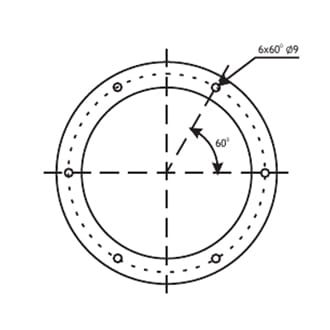
Elastomeric end seal, GSES-1S and GSES-1
| Test description | Typical value | Test method |
|---|---|---|
| Dielectric strength | 12 kV/mm (min.) | ASTM D149 |
| Tensile strength | 5 N/mm² (min.) | ASTM D638 |
| Elongation | 300% (min.) | ASTM D638 |
| Density | 1.23 gm/cm³ | ASTM D792 |
| Hardness | 60 ± 5 Shore A | ASTM D2240 |
| Continuous operating temperature | -200 °C to 180 °C | IEC 216 |
Published typical values for the rubber compound body. The despatch caps above are a different material and are tabulated on their own pages.
Six months in an open yard
Very little happens to the cap. It is qualified through 500 hours at 120 °C, stays flexible after four hours at -40 °C without cracking, and neither cracks nor flows under a heat shock at 250 °C. Continuously it is rated from -40 °C up to +110 °C. If the end has gone wet after two monsoons in a compound, the cap is rarely the reason.
What accumulates is chamber time. At 33 kV and above the insulation keeps giving off gas for as long as the drum stands, and the drum is heated to drive that out before anyone joints it. A scheduler treats those hours as a fixed queue, so the choice between a plain sealed end and a relief-valved one turns up as a slot in the programme rather than a line on the delivery note.
Re-handling runs one way only. A recovered cap comes off by being cut off and will not go back on, so every opening in store costs a fresh cap and, where it was printed, a fresh print. Sizes across the family are in the manufacturer's end-cap datasheet.
Sourcing is a separate page
Nothing above is an offer. Open End writes about these parts; it does not make them, hold them, price them or promise a date. Manufacture is Gala Thermo Shrink Pvt. Ltd., Mumbai. Distributor, dealer and manufacturer enquiries all belong on contact.
Asked at the despatch bay
Does an end cap apply to ABC cable?
Do both ends of the drum get the same cap?
Is the valved cap the same thing as the relief-valved cap?
Does the CV-line seal share anything with the drum caps?
Where the despatch decision continues
- Insulcap heat-shrink cable end capsThe default sealed build and the GEC size family.
- De-gassing end caps with relief valveWhy 33 kV and above changes the part.
- Tamper-proof end sealsWhat a printed seal proves in a dispute.
- End cap with pulling eyeFive codes, 150–450 kg, cable 28–112 mm.
- End cap size chartReading a GEC code by recovered diameter.
- Why end seals failFailures that begin at despatch and surface on site.
Send the drum, not the part number
Overall diameter over the sheath, voltage class, jacket type, whether the buyer pulls from the drum, and where it is going. Five facts turn a first email into an answer instead of a request for the same five facts back.