A pole crown is in air and still drinks water
IN AIR is the whole of a pole's exposure, and on its own it protects nothing: the crown is the single horizontal sawn face on an otherwise vertical part, so rain stops there rather than running off.
The crown is a different exposure from the pole
Place the crown on the scale before you place the pole. From ground line to top a pole sits IN AIR, and that is the most forgiving of the four bands to design against: no backfill, no tide, no duct standing full of water. The crown occupies the same band and behaves nothing like the rest of it, because it is cut square across the grain and faces the sky.
End grain takes water the way a bundle of open tubes does, so a crown wets deeper and dries slower than any sawn face further down. Drying opens checks along the grain, the checks hold water instead of shedding it, and each winter's freeze-thaw widens them a little further. Decay then works downward from the one face on the whole structure that nobody puts a ladder up to look at until the pole is already on a replacement list.
Two moulded parts are offered for that face and only one of them goes into the timber. The heat-shrink cap arrives expanded and recovers above 125°C (257°F) under a soft blue propane or butane flame; as the wall pulls down over the top, the hot-melt lining melts and penetrates the cracks and cavities in the pole top, reinforcing it as it cools. The push-on cap in moulded PVC covers precisely the same crown and does none of that. Everything further down this page follows from that one difference.
Heat-shrink pole cap, five sizes
A closed-top heat-shrinkable cap, lined inside with hot-melt adhesive and supplied in an expanded form. It goes on with a gas torch, closed end first, and the finished signal is adhesive showing all round at the skirt. Once recovered and cooled, the manufacturer publishes the construction as giving 100% environmental sealing to IP68.
- The lining reinforces a checked crown; the cap wall on its own only covers it
- One torch application, worked round the circumference from the closed top downward
- The same part serves a timber crown, a spun concrete top, a steel pole and a composite pole
| Exposure band | IN AIR, at the crown |
|---|---|
| Top diameters covered | 140-460 mm (5.5-18 in), in five sizes |
| Substrates | Wood, concrete, steel or composite poles |
| Lining | Hot-melt adhesive, entering checks and cavities on recovery |
| Sealing | 100% environmental sealing to IP68 |
| Recovery | Above 125°C (257°F), propane or butane torch |
| Applications per pole | One |
| Service life | More than 30 years |
| Maintenance after fitting | None |
What changes at the top once the crown is closed
Only the first is about water. The second and third are usually what gets the line funded.
- Rain no longer reaches the end grain, and it is the bond doing that rather than the shape. The lining sets round the full circumference of the crown, so there is no path in under the skirt.
- Birds stop using the crown. A domed top with no flat landing area prevents perching and nesting, which on timber is the same thing as stopping excavation at the top.
- The manufacturer publishes elimination of outages caused by flash-over and electrocution at the pole top. That is a claim about the top being covered, and it is worth reading as such before it is put in a business case.
- Freeze-thaw stops widening the checks, because the checks stop taking water.
- The crown stops being a recurring inspection item: more than 30 years of published service life from a single application, with nothing to revisit. How that behaves across a route rather than a pole is set out on utility pole top maintenance.
What is published against these caps, and what is not
- Size
- Five sizes span 140 to 460 mm (5.5 to 18 in) of top diameter. The manufacturer publishes the span and not a row per size, so a size is settled against a measured crown and nothing finer appears here. The span sits beside the cable, anode and gland codes on the size chart.
- Sealing
- 100% environmental sealing to IP68, claimed for the recovered cap with its adhesive lining. Read that as a bond round the crown, not as a cover shedding water by shape.
- Weathering
- Resistance to ultraviolet and ozone, published for both the heat-shrink and the moulded PVC cap.
- Tensile strength and elongation
- Held against ASTM D638 for the heat-shrink cap and against ASTM D638 for the PVC cap.
- Water absorption
- Held against ASTM D570, for the heat-shrink cap only.
- Heat ageing and heat shock
- Held against ASTM D2671 and ESI 09-11.
- Electrical and physical methods
- Dielectric strength against ASTM D149; volume resistivity against ASTM D257; dielectric constant against ASTM D150. The PVC cap is published against ASTM D149, ASTM D792 and ASTM D2240. None of these methods is decoded here, because what an end-cap datasheet proves does it once for the whole site.
- Not published
- No per-size dimension table for the pole range, no uplift or pull-off figure, and no cold-shrink pole cap of any description. Where the datasheet carries no number, none is printed. Ordering variants sit on the manufacturer's own page for this cap.
The fork is the torch, not the pole
Both parts fit the same five-size span on the same four substrates. What separates them is whether a flame is going up that pole at all.
| Decision point | Heat-shrink cap | Push-on PVC cap |
|---|---|---|
| Fitting | Gas torch, above 125°C (257°F), flame kept moving round the circumference | Pushed on by hand; no tools, no skill |
| Hot-work permit | Required, and on a live route that is often the binding constraint | Not required |
| What reaches the checks | Adhesive flows into cracks and cavities and reinforces the top | Nothing. The crown is covered, not consolidated |
| Ingress | 100% environmental sealing to IP68 | No ingress rating published |
| Impact | Not listed for the pole cap | Resists cracking on sharp-edge impact |
| Weathering | UV and ozone resistant | UV and ozone resistant |
| Birds | Perching and nesting prevented | Perching and nesting prevented |
| Freeze-thaw | Prevented by keeping the checks dry | Published as protecting the top from freeze-thaw damage |
| Coming off again | Cut away. The bond is permanent | Not bonded, so nothing has to be cut |
| A crown that has already checked | The case it exists for | The case it is not for |
Push-on PVC pole caps, where no torch is coming
Same crown, same band, closed a different way. The cap is moulded in a specially formulated PVC, pushed on by hand and finished in minutes, with no flame, no permit and no trained fitter. On a live distribution route, or anywhere a hot-work permit is refused, that is the only argument in the comparison that carries weight.
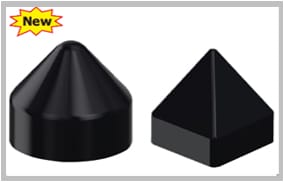
Round is the profile most poles take: a domed top on a parallel skirt. Square is moulded as a pyramid top on a square skirt, for a sawn or laminated post rather than a turned pole. Those two are what the manufacturer publishes; anything else is a moulding question to put to the manufacturer's page for the moulded cap, and this site quotes no tooling, stock or ordering position on it.
What is given up is the whole of the left-hand column. Nothing flows into the checks, a crown that has already opened is covered rather than consolidated, and no ingress rating is published for it. Closing a sound crown before it opens, that trade is usually the right one. Closing a crown that is already split, it is not.
Questions that come up before a crown is capped
Do I measure the crown or the pole?
Will a cap work on a crown that has already checked?
Does capping the top protect the rest of the pole?
Is this the same part as a dock pile cap?
Our contractor cannot get a hot-work permit. What then?
Is a pole cap the same thing as pile capping?
Where this decision goes next
Down the scale, out to the programme, or into the fitting detail.
- The same shape, one band deeperA timber dock pile cut flat in the SPLASH ZONE, wetted from underneath as well as from the sky.
- Capping a route rather than a poleSequencing a crown-capping programme against permit access, which is normally the constraint rather than the part.
- Fitting technique on timber, concrete and steelSoft blue flame with a yellow tip, never pencil-thin, never scorching; let the crown cool before any load goes back on it.
- The failure this cap is specified againstWater into end grain at a crown that was covered but never bonded.
- Every size figure on this site in one placeThe five-size pole span, alongside the cable, anode and gland codes.
Getting a crown size confirmed
Open End is a reference site: it does not make these caps, keep them on a shelf, or put a figure against them. Four facts turn a pole enquiry into a single reply: the measured crown diameter, the pole material, whether the crown has already checked, and whether a hot-work permit is obtainable on that route.