In air · Splash zone · Buried · Submerged
Every open end sits somewhere between air and water
Place the part on that scale first, then pick the cap. A drum end in a despatch bay, a pole crown in weather, a pile top in the tide and an anode lead wire under backfill are one situation at four depths: an end cut open that has to be closed again.
- In air - dry, indoor or above the weather. Dust and handling damage, not immersion.
- Splash zone - wetted and dried in cycles. The band that eats material fastest, because the surface never settles in either state.
- Buried - permanently damp, low in oxygen, and moving as the ground settles around it.
- Submerged - continuous immersion, where a cover is worth nothing and only a lined seal counts.
Why the axis is depth, not product family
Those four figures are the anchors. Every product page quotes them once and stops re-explaining them, leaving room for the thing that actually differs between one cap and the next: where it lives. The bands run down each page in the same order and never double back upward, so how far you have scrolled is how deep your part sits.
Depth settles three questions before a part number does. Whether you need a seal or only a cover, which are not the same claim. Whether the lining should be a hot-melt adhesive, which flows into an irregular sheath, or a rubber-based mastic, which has to bond to two dissimilar materials at once as it does at an anode. And whether the closed end will later be walked on, driven past or dug up.
A catalogue split by product family answers none of that. It files cable accessories in one chapter and marine hardware in another, which works only if you already know your chapter. A marina owner with soft pile tops and a distribution engineer with rotting pole crowns are buying the same moulded shape against the same water, and neither would find the other's page.
Four ways in, by what you are holding
Each route opens on its own band. If you already have a diameter, skip all four.
A cable end, before it leaves the works
Drum ends, spare cores, and ends bound for a duct that floods. Heat-shrink caps with a hot-melt adhesive lining close onto XLPE, PVC, PILC and rubber-sheathed jackets, GEC 001S to GEC 1101. Variants cover an energised end, an HV end that has to vent and an end pulled through the duct.
A pole crown or a pile top
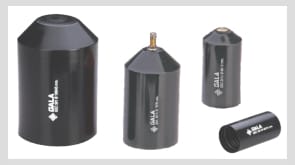
One moulded shape, five sizes, 140 to 460 mm (5.5 to 18 in) of top diameter, on wood, concrete, steel or composite. Two jobs at two depths: a wooden power pole crown in air, and a timber dock pile cut flat in the splash zone. Choose by substrate and band, not by the word your supplier uses.
A crimped terminal inside a panel
The shallowest band here, and the one where the hazard is a finger or a dropped spanner rather than water. A moulded PVC cap pushes on over the lug or stud with no torch and no adhesive, so the fit is neither permanent nor a seal.
An anode, or any buried joint that carries current
Buried, wet and energised at once, which happens nowhere else here. A cross-linked polyolefin cap lined with rubber-based mastic seals the lead-wire exit and takes the bending stress off it, GAC 0420 to GAC 0550. Its operating band is -55 to +100 °C, wider at the bottom and narrower at the top than the cable caps, so do not carry one figure across to the other.
The ranges every product page works inside
What this site is, and what it is not
Open End is a reference operated alongside the manufacturer of the parts it describes, Gala Thermo Shrink Pvt. Ltd. of Mumbai. It holds no stock, sets no price and quotes no lead time, and the contact page carries an address rather than a form, because a form that fails quietly is worse than none.
Two habits follow. Where a datasheet has no number, no number is printed: nothing finer than the five pole sizes, no cold-shrink end cap figure of any kind, no tariff code anywhere. And test methods stay out of the prose. Each standard reference sits in the Test method column of the table it belongs to, so a paragraph reads for the decision and the table is checked afterwards for the evidence.
If you already know what you are holding
Direct routes, for readers who do not need the argument above.
- Four size charts, and how to read a codeCable, anode, pole and gland codes in one place
- Fitting a cap with a gas torch, on five substratesClosed end first, and what scorching looks like
- Six ways a closed end opens againSorted by band. The failures differ by depth
- Closing an end where a torch is not allowedHot-work permits, gas zones and live plant
- A pile cap and pile capping are not the same thingOne search term, two unrelated trades
- What an end-cap datasheet actually provesRead once, then skipped on every product page
Send a dimension, not a product name
Give the outside diameter over the thing being closed, what it is made of, and which band it sits in for the rest of its life. Three lines is usually enough to answer with a size code instead of a question.