Splash zone
A timber pile top, in the splash zone, cut flat
The crown is the one end on the pile that a saw made, and on a dock it takes water from above as well as below.
Where the crown sits, and what is not published for it
Place the member before you place the part. One driven timber pile occupies three bands at once: submerged at the mud line, wet and dry twice a day through the tidal band, nominally in air at the sawn top. Only the third was made by a contractor, cut flat when the pile was driven to height, and it sits inside the spray envelope of every boat that comes alongside. That is why the crown is specified as splash-zone work rather than as a dry cover.
Two gaps, stated now rather than at the bottom. There is no per-size chart for this part — five sizes span crown diameters of 140 to 460 mm (5.5 to 18 in), with no table of individual codes published, so the size is settled against a measured crown. And this is not the pile cap on a foundation drawing; that one is reinforced concrete tying a group of pile heads together, and the two senses are separated on pile cap or pile capping.
The rest of the naming is one moulding wearing several labels. Piling cover, pile top cover, dock post cap and marine pylon cap all describe this part, and roughly half the people looking for it type cover while the other half type cap. Nothing turns on which word you use. Something does turn on whether you want a cover or a seal, and the manufacturer's dock pile cap page lists this one as the sealed version.
Dock pile cap, heat-shrink, adhesive lined
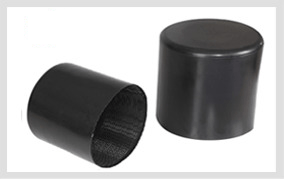
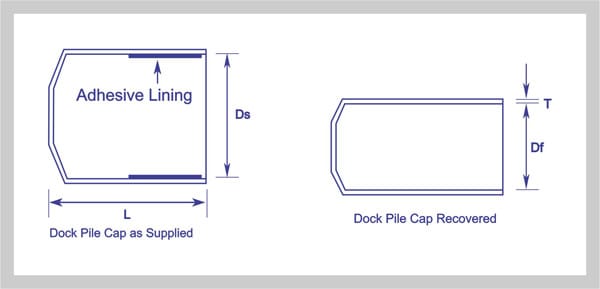
A heat-shrinkable cap with a hot-melt adhesive lining, moulded by Gala Thermo Shrink Pvt. Ltd. of Mumbai, supplied expanded and recovered over a pile top with a gas torch. What separates it from a push-on cover is what the lining does on the way down: the adhesive is driven into the checks and cavities in the cut face and cures there, so the crown is reinforced as well as closed, and the closure is a seal rated IP68.
- Adhesive penetrates checks and cavities and reinforces the cut face
- Impact resistant against sharp-edge strikes
- Denies birds a perch and woodpeckers a cavity at the crown
- Protects the crown against freeze-thaw damage
- Fits concrete, wood, steel or composite crowns in minutes
| Fits | Timber, concrete, steel and composite pile and pole tops |
|---|---|
| Crown diameter | 140 to 460 mm (5.5 to 18 in) |
| Sizes | Five across that span; no per-size chart published |
| Lining | Hot-melt adhesive, full bore |
| Ingress | 100% environmental sealing to IP68 once recovered |
| Recovery temperature | Above 125 °C (257 °F) |
| Heat source | Propane or butane torch, soft blue flame |
| Weathering | Resistant to UV and ozone |
| Service life | More than 30 years from one application |
| Maintenance | None after fitting |
What a pile cap does not do
Anyone costing a capping programme needs the limits more than the feature list, and no supplier writes them down.
- It does not reverse decay already under way. Sealing a soft crown seals in what is wet. Capping belongs to the sound piles, which is why the programme starts with a survey rather than an order — see marine and dock sealing.
- It does nothing below the waterline. Borer attack, abrasion at the fender line and wastage through the tidal band are separate problems on the same timber.
- It is not a structural pile cap. Nothing here transfers load between a pile group and a column.
- It is not a fixing point. The published instruction is to let the cap cool before mechanical strain reaches it, and nothing in the data makes it load-bearing once cold. Cleats and rope collars belong on the timber.
- It cannot be fitted cold, or fitted twice. Where a flame is not permitted the decision changes before the product does: see closing an end where a torch is not allowed.
- A push-on cover is not this part. The moulded PVC version goes over the same crown with no torch and no adhesive in the checks, and it is specified on pole caps.
Fitting one on a sawn crown
Torch technique across every substrate this site covers is on fitting a cap with a gas torch.
Square the top and clean it
Trim the crown flat, pull the staples, nails and old tag wire, and brush the face back to dry timber. Loose fibre left underneath becomes a channel the adhesive has to bridge instead of a surface it can key to.
Measure across the widest point
A pile that has been in service is not round. Take the largest dimension across the sawn face: the supplied bore must pass over it and the recovered bore must want to close below it. The notation is explained on the size charts.
Seat the cap square
Push the expanded cap down by hand until it is seated and vertical. A cap started crooked recovers crooked, and the finished edge lands at a different height around the pile.
Heat from the closed end down
A soft blue flame with a yellow tip, propane or butane, kept moving round the circumference. Take the cap above its 125 °C (257 °F) recovery temperature and work towards the open edge. The finish is visual, not timed: stop when a bead of adhesive shows all the way round.
Let it go cold before anything touches it
No rope, no fender, no load until the cap is cool. The adhesive is still mobile while the moulding is warm, and this is the instruction that gets skipped because the cap already looks finished.
The part, the crown and the dimensions

What dock owners ask
Is this the pile cap on my structural drawings?
Cap, cover, piling cover or dock post cap?
What do I order for a 300 mm pile?
Will it keep woodpeckers off the crown?
Does it hold up through a northern winter?
Can it go on without a flame?
Where to go next
- Marine and dock sealingThe asset surveyed band by band, and a capping schedule by element.
- Pile cap or pile cappingThe concrete sense of the word, separated from this one.
- Pole capsThe same moulding on a utility crown, plus the push-on PVC version.
- Fitting a cap with a gas torchTechnique on five substrates, and the four ways a fitting goes wrong.
- Six ways a closed end opens againFailures sorted by exposure band, including the crown.
Send a crown diameter, not a part number
Measured across the widest point of the sawn face, with the pile material, how many crowns are in the programme, and whether a hot-work permit can be raised on site. Those four settle the size and whether heat-shrink is the right answer at all.